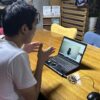
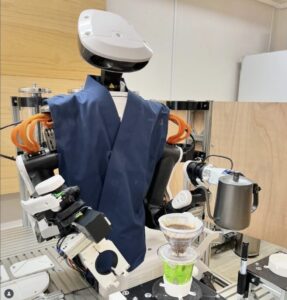
As I step through the doors of Hare to Ke, I am warmly greeted by Noguchi, the owner of the café, and her two robot employees, Dori and Dora.
The café has a cozy and welcoming atmosphere, where every detail feels thoughtfully placed. From the carefully selected products on display to the gentle harmony between tradition and technology, it is clear that Noguchi has a deep dedication not only to her surroundings and the environment but also to the people who step into her space.
There is a quiet warmth here—one that invites you to slow down, take a seat, and simply be.
Noguchi:
-168x300.jpg)
“The name ‘Hare to Ke” comes from a concept expressed by the folklorist Kunio Yanagita.
“Hare” refers to the extraordinary, while “Ke” represents the everyday.
Robots are still not part of our daily lives—they are still something special.
But I hope for a future where they can coexist with us and become part of our everyday routines.
At the same time, the concept also reflects the importance of daily life—especially eating.
The ranma (traditional transom) in the shop is another example.
It used to be a normal feature in Japanese homes, but today it feels almost extraordinary.
Through this space, I wanted to express how the boundary between the ordinary and extraordinary changes over time.
I also want to preserve and share Japanese cultural traditions.
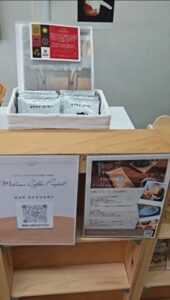
For example, we sell dorayaki made with rice flour.
Normally, they are made with wheat flour, but since Japan has a strong rice culture, we use rice instead.
We grind the beans fresh so customers can fully enjoy the aroma.
Personally, I love drip coffee, and I feel it’s gentler on the body compared to espresso.
At home, I use a Hario V60.
In the café, we also use a dripper that allows us to brew multiple cups at once when it gets busy.
I’m originally from Kansai, so I wasn’t very familiar with Saitama.
When I was looking for a place to open the café, friends recommended Urawa.
It’s known as an educational district, with a strong focus on children and learning.
It has both urban convenience and access to nature, which creates a really nice balance.
That idea of “balance” also connects to the concept of this café.
There are many children in this area, and there are kindergartens nearby, so a lot of kids visit the café.
It makes me really happy to see so many children here.
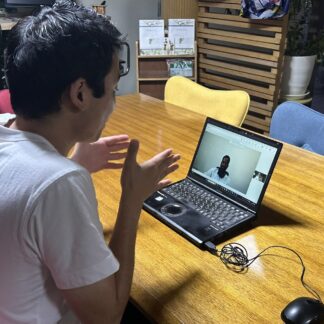
My connection to Malawi started through students from a nearby school.
They first came as regular customers, but they had a strong passion for promoting fair trade.
That eventually led to our collaboration.
It felt like a meaningful connection, and I was really happy about it.
The café is not the final goal—there is more I want to do beyond it.
In Japan, many farmers are aging, and there is a shortage of successors.
Since eating is essential to life, food is incredibly important.
In the future, I would like to grow vegetables in an environmentally friendly way, without pesticides,
and bring back traditional farming and produce.”
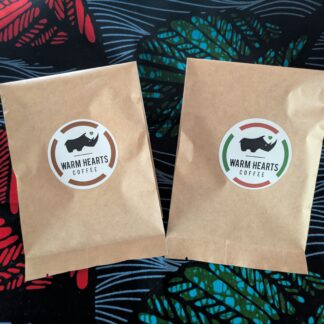
As I listen and chat with Noguchi, I take a sip of the Malawian coffee that Dori has carefully brewed for me.
The bright yet gentle flavors of the beans, shaped by their unique terroir, blend seamlessly with the warm and calming atmosphere of the café. In that moment, I feel both relaxed and quietly satisfied.
Hare to Ke is a truly unique concept—one that bridges the everyday and the extraordinary.
If you ever find yourself nearby, I would highly recommend stopping by to experience it for yourself and to meet Noguchi and her two charming and dedicated robot companions, Dori and Dora.
Do you also want to taste the warmth of Malawi in a single cup—while helping provide school meals for children?